
Gear that makes video look and sound better
As an Amazon Associate I earn from qualifying purchases.
Mr. GetMen: a songwriter from Ukraine who took the whole path
Every AI music comparison on the internet, ours included, is written by someone who tested the tools. Almost nobody writing about them has taken a track through writing, generation, mastering, artwork, distribution, an Official Artist Channel and paid promotion. Mr. GetMen has, five times.
He is a songwriter from Ukraine. He writes all of his lyrics himself and uses Suno for the music and vocals, and he distributes through DistroKid to Spotify, Apple Music and YouTube Music. He wrote to us in August with a set of prompting notes that our own Suno vs Udio vs Riffusion comparison could not have produced, because they come from releasing the output rather than testing it. He publishes as Mr. GetMen, and that is the only name this piece uses.
His first email to us said seventeen tracks, all distributed. Before we had published anything, he corrected it himself:
“Seventeen is how many songs I have written this year. Five are actually out: an album track, three singles and the flagship. The rest are finished and scheduled: one release a month through February 2027.”
“What is true is that I have taken the full path several times: writing, generation, mastering, artwork, distribution, the artist channel, paid promotion, the lot.”
The Scribe and the Lirnyk: how one human and one machine make a song
Mr. GetMen is two figures, and the split between them is the clearest account of who authors an AI-made song that we have heard from anyone who releases them. The Scribe is the human: he writes the words, the ideas and the research, and in his words he “stays faceless and off to the side, because the focus is the text and the meaning, not the author.” The Lirnyk is the machine that sings them.
The name comes from Ukrainian tradition. A lirnyk was a blind, wandering folk singer who performed dumas, the long epic ballads of grief, war and memory, to a hand-cranked lira. He explained why that figure fits the AI:
“He carried the songs from town to town and gave them a voice. He sang, as you put it, from the soul rather than the eye. That is exactly what the AI is here: no eyes, no face, no authorship … it only gives voice to what the Scribe has written.
So the whole method fits in one line: the Scribe writes, the Lirnyk sings. The human composes; the non-human gives it voice. And out of these two comes the composite figure of Mr. GetMen.”
The Lirnyk has a body, too: a motanka, the traditional Ukrainian cloth amulet-doll that is always made without a face.
“You never draw features on a motanka; the blankness is the point, keeping the figure universal and anonymous, a vessel rather than a person. Two things never change on the Lirnyk: first, his face is a cross woven from patterned ribbon; second, he carries a feather that is also a star … the Scribe’s quill turned into light. Everything else changes: for each song he puts on a different costume and becomes a different character … He’s an actor, not a logo.”
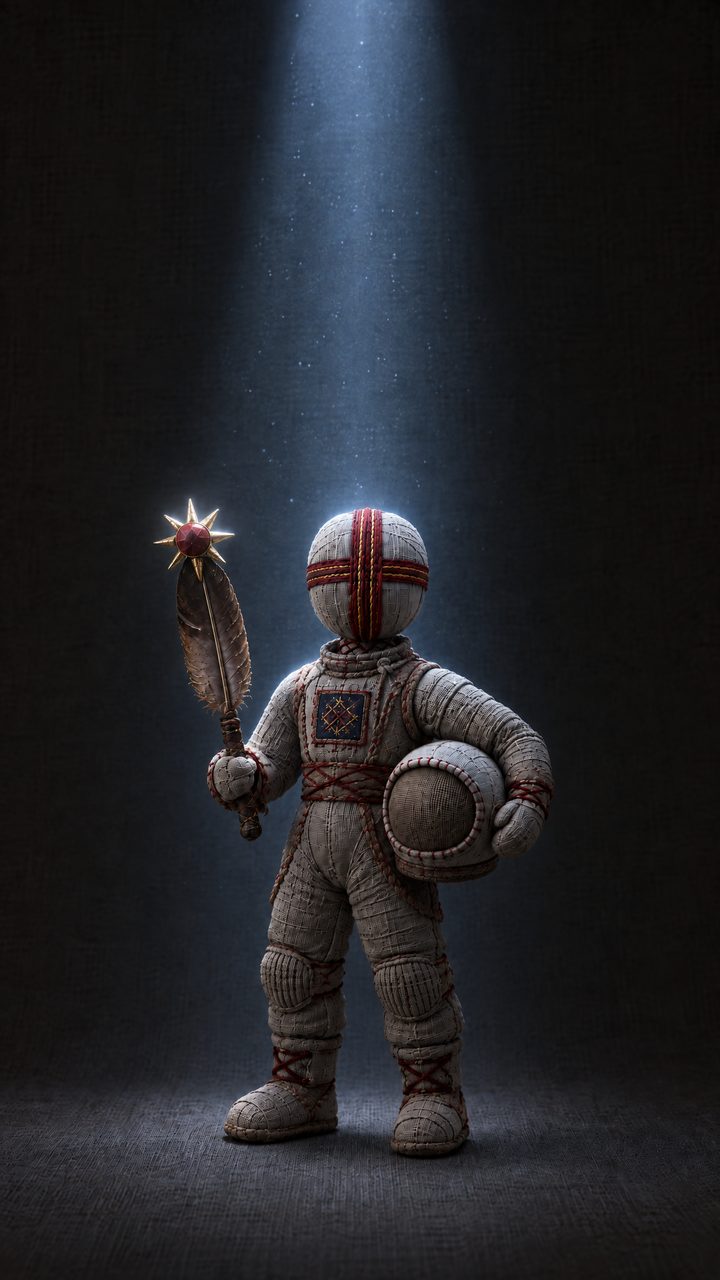
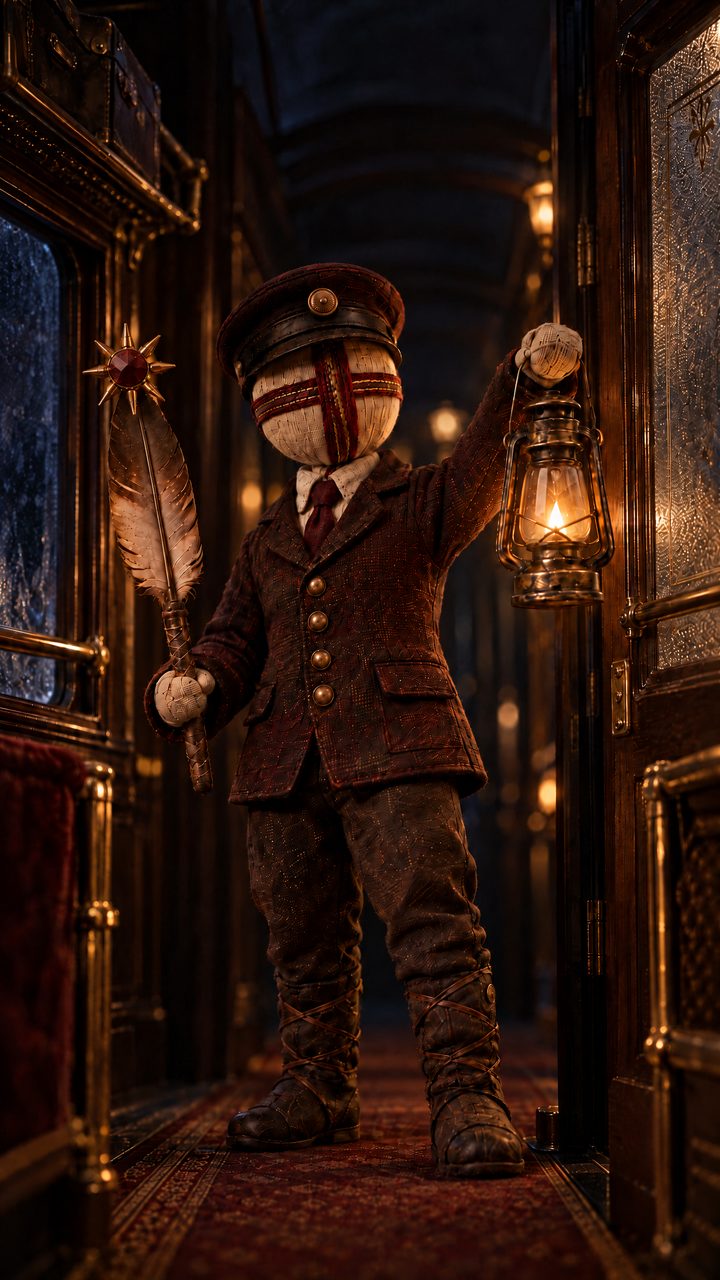
The ribbon cross and the star-feather stay; the costume is the song. For anyone working out how to present AI-made music honestly, it is a working answer: the human keeps the authorship, the machine is credited as the voice, and neither pretends to be the other.
Paid promotion: $200, 140,000 views, zero subscribers
The one hard number in the interview is about what money can and cannot buy for a song, and it is the reason this piece leads with it. We asked whether any of his tracks perform. Part of his answer:
“The one hard number I have is from paid promotion, and it is instructive. I put two hundred dollars into YouTube ads on one video. It returned a hundred and forty thousand views, eighty-three percent of them in Ukraine, with an average watch time of two minutes thirty-one on a three-twenty-seven track, about seventy-three percent completion, which for cold advertising traffic is high. Subscriber growth from that campaign: zero.
So: the song holds people. The advertising does not convert holding into a relationship. Attention is purchasable, audience is not, and I would not have believed the gap was that clean before I saw it.”
Source: Mr. GetMen, one paid YouTube campaign on one video, reported in correspondence with Rinzara, August 2026. Completion is his own figure (2:31 of 3:27, about 73%). One campaign by one artist; read it as a case, not a benchmark.
Everything below is about craft: how to get the song good enough to hold people for 73% of its length. Keep the zero in mind while reading it. Nothing in the craft section turns attention into an audience, and he is the first to say so.
Genre anchors beat negative instructions
A vocal that drifts into talking was the first problem his email led with, and his fix does not start with a ban. It starts with naming a kind of music in which nobody talks.
The triple ban on spoken word: what does that look like literally, word for word, in the style field?
“In the style field, at the very end, always in this order: NO spoken word, NO rap, NO narration, ONLY SINGING from the first line to the last.
The final clause matters. Without ‘from the first line to the last’ the model would sing the chorus and narrate the verses, which is worse than either.”
Asked whether that string survives model updates, he was careful not to overclaim: he does not run controlled tests across versions, he notices when something breaks and re-tunes, and this particular string “has held while other things I relied on stopped working.” The part he considers more useful is what comes before the ban.
“Negative instructions alone don’t get you singing. What gets you singing is a genre anchor: naming a genre where nobody speaks. On one track I fought recitative for four rounds describing the voice I wanted: ‘restrained,’ ‘calm,’ ‘hypnotic,’ ‘spoken-sung.’ Every one of those pushed further into narration, because they are all descriptions of how someone talks. The fix was to stop describing the delivery and name ‘gothic metal ballad’ instead. The model has no speaking examples in that bin.
Third element: sustained notes. ‘Sustained sung notes,’ ‘long held notes.’ You physically cannot speak a held note. That constraint does more work than any prohibition.”
- Genre anchor. Name a genre where nobody speaks. Do not describe the delivery.
- Sustained notes. “Sustained sung notes,” “long held notes.”
- The ban, last.
NO spoken word, NO rap, NO narration, ONLY SINGING from the first line to the last.
His own summary: “the actual recipe is genre anchor + sustained notes + triple ban, and the ban is the least important of the three.”
The style field describes the song; brackets suggest a moment
His first email included one line we had never seen written down: the fix for rushed lines goes in the style field, not in brackets. We asked whether there was a rule behind it.
What else behaves differently depending on which of the two it goes in? Is there a rule, or is it case by case?
“I think the underlying rule is this: the style field is read as a description of the song, brackets are read as a suggestion about a moment. The model applies descriptions and negotiates with suggestions.”
Style field, or it will not survive
- Pronunciation and word stress
- Pace: “every word distinct and fully pronounced, NO rushed lines, NO swallowed words”
- Vocal type
- Tempo
- Genre
- Prohibitions of any kind
Brackets, often enough to be worth it
- Emotional colour on a single line: (quiet, curious), (annoyed), (almost whispered)
- Lands “maybe two times in three, and when they miss nothing is lost”
Both places, if it must happen
- Silence. Tagged three separate times in one song’s lyrics, it “never happened once.” In a different song it worked because it was also written into the style field: “SUDDEN SILENCE, music stops completely on the line X, then continues quietly.”
His standing rule from that experience: “if it must happen, it goes in both places.”
The model reads letters more reliably than it reads instructions
This is the most transferable finding in the interview, and he did not expect it either. When a word keeps coming out wrong, he stops asking and starts spelling.
- “If a word keeps getting the wrong stress, put a diacritic on the stressed vowel and it holds.
- If you want a word stretched, write the stretch into the word (‘za-a-araz,’ ‘fa-a-all’) and it stretches.
A bracket note saying (drawled) is a coin flip; changing the spelling is not.”
There is a limit, and he names it: “mark every word and the model starts chanting syllable by syllable, so mark only the ones that keep going wrong.” The practical reading for anyone writing in a language with variable stress is that the spelling of the lyric is itself a control surface, and a more reliable one than an instruction about the lyric.
Naming a decade summons a person, not a sound
This is the finding with consequences beyond craft. He wrote a satirical fable in Russian and asked for a 1970s bard song: solo acoustic guitar, warm male voice, storytelling. He called it a reasonable request.
“What came back, generation after generation, was unmistakably Vysotsky: the rasp, the pressure, the particular way he attacked consonants. Not an imitation I asked for.
Just the centre of gravity of everything the model has filed under ‘1970s Russian-language man with an acoustic guitar.’ I did not want that. Partly because the song was not his kind of song, partly because a recognisable dead singer’s voice on my track is a problem I do not need.”
The voice in question belongs to Vladimir Vysotsky, the Soviet-era singer-songwriter. His fix was “negative and specific”: no raspy voice in the style field, plus naming the qualities he wanted instead of the era (“energetic male warm voice, melodic storytelling, minimalist acoustic, voice and guitar only”). He now adds no imitation of any famous singer as a standing clause on anything era-flavoured.
“Worth saying plainly to your readers: if you name a decade and a language and an instrument, you are not describing a sound, you are describing a bin, and the model will hand you whoever is at the centre of that bin. Sometimes that is a genre. Sometimes it is a person who has heirs.”
A recognisable voice arriving uninvited inside a generation is a rights question, not only a taste question. Our guide to whether AI voice cloning is legal covers the voice side, and the Suno ruling tracker covers what that means for selling the track. This is information, not legal advice.
A good take is the point to stop touching the style field
His process rule took him, in his words, “longer than it should have to work out.”
“Don’t chase the perfect generation from scratch. Find the take where the voice, the tempo and the mood are right, even if details are wrong, and then stop touching the style field entirely. Change only the performance instructions inside the lyrics: quieter here, whisper this line, open up on the chorus, drop the drums before this word. Regenerate from that same take.
The reason is that the style field controls what kind of song this is, and rewriting it gives you a different song. The bracket notes control how this song is performed, and changing them gives you the same song, sung differently. Once you understand that split, you stop losing good takes to small fixes.”
He lost several strong generations early on, he says, “by trying to correct one detail in the style field and getting something completely unrelated back.”
Two voices in one song: what listeners actually hear
His first email described changing the arrangement between verses to suggest a second speaker. We asked whether it really works.
When you change instrumentation between verses, do listeners hear two different singers, or one singer and a mood change? How did you check?
“They hear one singer and a change of speaker. Not two singers. I should be straight about that.
The song is a dialogue: two verses in a boy’s voice, the third in his father’s. I could not get two timbres however I wrote it. What worked was changing the arrangement: fingerpicked acoustic guitar and brushed drums for the boy, cello and low strings entering for the father, everything heavier and slower.
How I checked: badly, honestly. No listener panel, no blind test. What I have is that nobody who has heard it has been confused about who is speaking, and that the lyrics name both speakers anyway: the father asks a question in the first line, the son calls him ‘dad.’ So the arrangement may be doing less work than I credit it with, and the text more.”
Two genuinely different voices in one track is first on his list of failures he has not solved: “Never solved, only worked around.”
Lyrics are a prompt too, and they can overrule the style field
The rest of his unsolved list points at one idea: the words of the song are instructions as well. Programmed silence still fails often enough that he fixes it by hand (“Roughly one attempt in four, even with the doubling described above”), inserting two seconds of silence in an editor, “which takes a minute and works every time, which tells you something about where the frontier actually is.” Long unrhymed lines slide into recitative: “Rhyme and short lines are a kind of armour against it; a documentary-style lyric with uneven lines has no armour.”
The clearest case is a song he is writing that opens in 1968, with the Apollo 8 Earthrise photograph, the arms race and the treaties that followed. He wanted it to sound like now. Every early generation sounded like then.
“At first I blamed the style field and rewrote it. Then I looked at what I had actually written and found I had done it to myself: I had asked for mellotron and vintage synth pads, because I had been thinking about a certain famous space song from that period. So I stripped all of it out and got the sound of 1985 instead, because arpeggiated synthesisers are their own decade. Stripped those, went guitar-only, and finally landed somewhere contemporary.
But the lyric itself keeps pulling. Even now, with synthesisers banned outright in the style field, the model drifts period-ward on that track more than on anything else I have made. My working theory is that the words are doing it: dates, a space programme, nuclear anxiety. The text is a prompt too, and I have no clean way to override it except to keep generating.”
“Most of the time I spend fighting the tool is actually time spent finding out which of my own words was giving the order.”Mr. GetMen
The full version of that lesson, in his words: “The style field is not the whole instruction. The lyrics are also an instruction, the title is an instruction, and they can quietly disagree with each other.”
Distribution said no exactly once, and not about AI
Across five releases, the platforms have rejected him once, for a reason that had nothing to do with how the music was made.
Did DistroKid or any platform reject anything, and on what stated grounds?
“None on content grounds, from any platform. The only rejection I have had was mechanical: a title in Cyrillic came back as invalid, with a message telling me to romanise the name in parentheses. So the release went out as the Cyrillic title with a Latin transliteration in brackets. That is the entire history of platforms saying no to me.
Nobody has ever asked me how the music was made.”
The YouTube Official Artist Channel was equally uneventful, in his account: “Nothing unusual. Requested through the distributor, confirmed within a few weeks, no additional questions about how the music was made. The topic channel merged into it the way it does for anyone.” For the current state of each platform’s written rules, see our tracker of which AI music generators are safe to sell.
Disclosure started as ethics and turned into a hedge
Spotify’s AI persona labelling was, in his words, set to roll out in mid-September 2026. He answered our question about it in August, before the rollout, and his answer is about the gap between what a policy says and how it gets applied. For Spotify’s own framing of its AI rules, see its September 2025 AI protections announcement.
“Where I think the line sits: the policy language is about whether the artist represents a real person, not about whether the production used AI. By that reading I am fine. I am a real person with a pseudonym, the way half of music has always worked. The lyrics are mine, and the songs are about my street, my son, war etc.
Where I suspect they land in practice: they will screen on signals, and my signals look exactly like a synthetic act. No face, no name, no interviews, generated vocals. A reviewer looking at my profile for eight seconds has no way to tell me from the thing the policy exists to catch.
So what I have done is push everything human I have into the profile that does not break anonymity. Biography in first person. The city I live in. The division of labour stated plainly: I write the words, the music and vocals are made with AI. Not because I am virtuous about it, but because the day this becomes a compliance question, the artists who hid it will be in a much worse position than the artists who said it in their bio a year earlier.”
“That is the part I would want your readers to take away,” he wrote. “Disclosure started as an ethical preference for me and turned out to be a hedge.”
Six days later the prediction got a test case. Australia’s chart body ARIA ruled that a release must be “substantially human made” to chart (BBC report), and he wrote again, unprompted. By ARIA’s standard, he said, he is out: “Words are mine, everything else isn’t.”
“ARIA says it can retrospectively adjust chart positions and ask for Number One awards back if a track later turns out to be AI-generated. That’s the part I’d underline for your readers. The risk isn’t being excluded; it’s being included and then unwound. Everyone who didn’t disclose is now sitting on that.
Which is the same point I made to you about the Spotify labelling, except now it’s not a prediction.”
He added a point he marked as his own rather than industry news: “the rule draws the line at performance, not at authorship. Under ARIA I would qualify if I sang badly over the same track myself. I’m not arguing they’re wrong (a chart is entitled to define what it rewards), but it does mean the standard measures who made the sound, not who made the song.” The licensing side of that distinction is covered in our guide to AI music licensing for commercial use.
Prompt craft did not correlate with performance at all
This was the answer he said he would have wanted before he started.
Do any of the tracks perform, and did prompt craft correlate with that?
“No correlation at all, and I want to be precise about this because it is the answer I would have wanted before I started. The tracks with the most carefully engineered prompts are competent. The tracks that got a real response are the ones where the words came from something that actually happened.
The strongest thing I have written is a conversation with my son about his school. He started first grade when the full-scale war began, so he has never known a school without air raid alerts. He came home and told me about his day in one continuous stream (maths test, the German teacher, the PE teacher all the girls like) and in exactly the same tone, without any change of voice, that they had gone down to the basement mid-lesson and only just made it. He was not complaining. To him it was not remarkable. There is no prompt that produces that.”
The opposite case is a track built to be catchy: short, one repeated word, a teenage subject. He rewrote that chorus six times in an evening, counting syllables, moving the stress, adding call-and-response. “Each version was technically better than the last. None of them stuck. The melody never arrived, and no amount of text engineering summoned it.”
“Craft gets you a floor. It does not get you a ceiling.”Mr. GetMen
What he would tell himself before track one
Three things, he said: one about the tool, one practical, and one he called less advice than a position.
“First: the tool solves the part you assumed was the hard part, and does not touch the part that actually decides. I thought the obstacle was that I could not compose or sing. The obstacle was whether the words were worth singing, and that was always the obstacle.
Second, purely practical: write down the style prompts that work and keep them. I have a small file of four or five canonical style strings, and each one took several frustrating evenings to arrive at. Reusing them has saved more time than any other single habit.”
The third is the honest position on what these tools are for, and it is the part of the interview we would least want shortened:
“What comes out of these tools is a draft. I want to be plain about that. I would rather have a real singer with real breath in the take, real musicians arranging it, someone who disagrees with me about the second verse. That is better, and I am not going to pretend otherwise.
But I do not have those people. No conservatory friends, no band, no contacts in the industry, and I live in a country where the music economy has other priorities right now. Without these tools the songs stay as notes in my phone. With them, they exist, they are on streaming platforms, and one of them was watched a hundred and forty thousand times by people who understood every word.
I think that is the honest frame. Not a replacement for musicians. An entry point for someone who has words and no other door. If a real singer ever wants one of these songs, I will hand it over gladly and the AI version will become what it always was: the demo. Until then, the demo is the song, and it is out in the world, and that beats silence.”
By late August that preference had hardened. After the ARIA ruling he wrote: “I told you I’d rather have a real singer. That was a preference on Monday and it’s closer to a plan today.”
Where to hear Mr. GetMen
Links in the order he gave them, which is his order of usefulness.
Following him on Spotify, or subscribing on YouTube, is the one thing his ad campaign could not buy.
One more story is coming. On 25 September 2026 he released “Sinners in Your Eyes”, a song built on a hymn to the city of Babylon, a text that researchers at LMU Munich reassembled from clay fragments using AI. It is a different kind of story from this one, and it gets its own piece.
Frequently asked questions
How do you stop Suno from speaking instead of singing?
Mr. GetMen's recipe has three parts, in order of importance: a genre anchor (name a genre where nobody speaks, such as "gothic metal ballad", instead of describing the delivery), sustained notes ("sustained sung notes", "long held notes"), and a ban at the very end of the style field: "NO spoken word, NO rap, NO narration, ONLY SINGING from the first line to the last." He says the ban is the least important of the three, and that without the final clause the model sang the chorus and narrated the verses.
What goes in the Suno style field and what goes in brackets?
His rule is that the style field is read as a description of the song and brackets as a suggestion about a moment. Pronunciation and word stress, pace, vocal type, tempo, genre and every prohibition go in the style field. Emotional colour on a single line works in brackets about two times in three. Anything that must happen, such as a programmed silence, goes in both places.
Did DistroKid or the streaming platforms reject AI-made music?
Not on content grounds, in his experience. Across five releases his only rejection was mechanical: a Cyrillic title came back invalid and had to carry a Latin transliteration in brackets. His Official Artist Channel on YouTube was confirmed within a few weeks with no questions about how the music was made.
Does paid YouTube promotion build an audience for an AI-made song?
In his one campaign, no. He put $200 into YouTube ads on one video and got 140,000 views, 83% of them in Ukraine, with an average watch time of 2:31 on a 3:27 track, about 73% completion. Subscriber growth from the campaign was zero. His summary: attention is purchasable, audience is not. This is one campaign by one artist, not a benchmark.
Will the Spotify AI label affect an artist who writes their own lyrics?
His reading, given in August before the rollout, is that the policy language is about whether an artist represents a real person, not about whether production used AI, so by that reading he is fine. He expects screening to run on signals, though, and says his look synthetic: no face, no name, no interviews, generated vocals. His response was to state the division of labour in his biography: he writes the words, and the music and vocals are made with AI.
Sources
- Mr. GetMen, written answers to Rinzara’s interview questions, August 2026, with follow-up notes on 26 August and 25 September 2026. Every quote and figure attributed to him on this page comes from that correspondence.
- Suno, the generator he uses for music and vocals.
- DistroKid, his distributor to Spotify, Apple Music and YouTube Music.
- Spotify Newsroom: Spotify Strengthens AI Protections for Artists, Songwriters, and Producers (September 2025).
- YouTube Help: Introduction to Official Artist Channels.
- BBC News: Songs created by AI banned from Australia’s music charts.
- Vladimir Vysotsky, the singer whose voice surfaced in his 1970s bard-song generations.
This article is an interview and educational information, not legal advice. Platform policies on AI-made music are changing quickly; confirm current rules with each platform before relying on them. Published October 2026.