The track, in numbers
These are his figures from his own account, one track out of five released. They describe one song, not how AI music works in general.
Two photographs, fifty-eight years apart
Earthrise is a photograph of Earth taken from lunar orbit by Apollo 8 astronaut William Anders on 24 December 1968 (Wikipedia: Earthrise). Its 2026 counterpart, Earthset, was taken by astronaut Christina Koch aboard the Orion spacecraft Integrity during Artemis II, which launched on 1 April 2026 (Wikipedia: Artemis II). The two frames run in opposite directions, and the song is built on that.
Earthrise, 1968
- Taken
- 24 December 1968, from lunar orbit
- By
- William Anders, Apollo 8
- Motion
- Earth rises over the limb
- Note
- The published frame is rotated 95 degrees clockwise from the crew’s original orientation
Earthset, 2026
- Taken
- During Artemis II, launched 1 April 2026
- By
- Christina Koch, aboard Integrity
- Motion
- Earth sinks behind the edge of the Moon
- Note
- The page we checked does not give the date of this frame, so we do not print one
Our drawingSchematic, not the photographs. The arrows show the direction of motion; the colours borrow the amber and cold blue he describes for his video, not the colours of the photographs. Facts from the Wikipedia pages linked in the sources.
Mr. GetMen followed the mission closely in April and met the Earthset photograph in the summer.
“In April I followed the Artemis II mission closely. Then, in summer, I saw the Earthset photo, the Earth sinking behind the edge of the Moon, and it reminded me of something. I searched and found it: Earthrise, Apollo 8, 1968. The same frame, fifty-eight years apart, running in the opposite direction.”
He sets the first photograph against its decade. In his telling, 1968 was the height of the Cold War, and in the years after it came the Non-Proliferation Treaty, SALT I and the ABM Treaty, and the Doomsday Clock moved back. He is careful about what that proves.
“One photograph didn’t do that alone, but it showed everyone the same small planet, with no borders on it.”
The song lays that picture over the new mission and over “a world that has again come far too close to the edge of nuclear war”, in his words.
What in the song is real
He says every fact in the song is real and checked. These are the ones that can be checked on a public page, and one he told us that we could not match:
- The flyby silence. The Artemis II page gives a planned loss of signal of 40 minutes, starting at 22:46 UTC, with signals from Earth recovered at 23:24 UTC. Those two times differ from 40 minutes by two minutes on the page itself, so we say about 40 minutes.
- The cookies. The same page says the crew “briefly gathered, for about 30 seconds” to share maple leaf cream cookies, and that crew member Jeremy Hansen called it a “surreal moment”. The Canadian Space Agency had announced a Canadian food package including maple cookies back in February. We use the page’s 30 seconds; the three minutes in the lyric is artistic text, he told us, not a fact.
- The crater. The crew proposed names for two unnamed craters they saw on the flyby: one for their spacecraft, and one for a crew member’s late wife. At his request the crew member is not named here.
- A message of love. Pilot Victor Glover spoke to ground control on 6 April 2026, as the crew neared the Moon, about love as one of the most important mysteries on Earth (NewsNation). The song’s line is “We love you from the Moon.” We could not match his exact wording to a public page, so we do not quote it.
One thread is his own. On Christmas Eve 1968 the Apollo 8 crew read the first ten verses of the Book of Genesis in a television broadcast from lunar orbit (Wikipedia: Apollo 8), and that is what led him to put his own questions to God in the song.
“That moment pushed me to put my own questions to God in the song, ‘Why, Lord?’ And to end it not with an answer, but with the only thing we can honestly say: ‘Still here, Lord.’”
There is also a Ukrainian thread. Yuri Kondratyuk was born in Poltava in 1897 and is credited with an early lunar-orbit rendezvous concept (Wikipedia: Yuri Kondratyuk). His book The Conquest of Interplanetary Spaces was printed in Novosibirsk in 1929, 2,000 copies, at his own expense (the book’s own Wikipedia page). At 3:33 in the video the cover of that book appears on screen.
“It felt right that a song about the Moon should remember him.”
Suno argued back
The music and vocals were made in Suno. His first style prompt leaned on a Bowie-like feeling.
“My first style prompt leaned on a Bowie-like feeling: mellotron, vintage pads, warm analog sound. Suno took it literally and gave me pure seventies.”
He rewrote it as modern cinematic rock, and Suno then returned a melody almost identical to his previous song, “Sinners in Your Eyes”: the same baritone and the same sustained notes, because that was the nearest familiar template. So he changed the rhythmic base instead of the voice, and slowed the track down.
Two smaller findings mattered more than he expected, and both were in the lyrics. A note such as “spoken-singing” inside the lyrics pulls Suno into recitation, so it had to go. And ellipses around the title line made the model break it into pieces, while “Not enough craters on the Moon for our names” has to be one unbroken phrase, because the whole song leans on it.
The count: fourteen generations, then eight remix rounds
He generated fourteen times. Then he took the last generation and remixed it: seven remixes kept, and he stopped at the eighth. The first version ran 6:12; the final track is 6:25.
Our drawingCounts and lengths are his. The bars are drawn from 0:00, so the 13 seconds he added are visible as the gap, not exaggerated. He did not tell us which generation produced which finding, so none is placed on the strip.
The final style prompt, and what it replaced
The prompt that opened the work, as he quoted it, and the one he ended with, as he gave it:
Read it as a prompt that describes the song’s sound and mood in plain terms, with no decade and no artist named. The “radio static” and “vinyl noise” chips sit in the prompt, but the static that opens and closes the finished track was added by hand, in Audacity, as the next section describes.
What may carry over, and what may not
Three things from this one song are worth trying on your own tracks. Each comes from a single song, so each is a lead, not a rule.
Naming an era gets you the era
A Bowie-like prompt with mellotron and vintage pads produced “pure seventies” for a song about 2026. The same pattern he reported in our first interview: name a decade and an instrument and you describe a bin, not a sound.
Your nearest template may be your last song
When he moved the style away from the seventies, Suno returned a melody almost identical to his previous track, with the same baritone and sustained notes. He broke the loop by changing the rhythmic base, not the voice.
Punctuation can cut a phrase
Ellipses around the title line made the model break it into pieces. Written as one unbroken line, it sang as one.
What this does not show: that any of these will hold on another model version, another genre, or another songwriter. That is the point of asking every artist the same questions below.
- Era swap. Take a prompt that names a decade or an artist. Replace each with two plain words about the sound (for example “warm” and “slow”) and generate again. Note whether the era still shows.
- Template check. Play your newest generation straight after your last released song. If the melody or the voice lines up too closely, change the rhythm or tempo before you change the voice, which is the order that worked for him.
- Punctuation strip. If a line you care about comes out in pieces, remove the ellipses and dashes around it and write it as one unbroken line.
The hands-on part
The static that opens and closes the song was added in Audacity, and he worked on its level so it sits like a lost signal rather than noise. In CapCut he laid the video over the audio, edited the clip, cut the Shorts and added the subtitles.
The video was generated in InVideo: 29 scenes, usually one or two generations per scene, rarely three or four. The concept is three worlds: amber 1968 with film grain, the cold blue of lunar orbit, and an almost monochrome flat today. Earthrise and Earthset stand side by side, as on the cover, and the cookies float in zero gravity.
The one real problem was light.
“At first I asked for candles, and InVideo started putting candles almost everywhere. When I went through the frames, it was too much, the candle stopped meaning anything. So I replaced most of them with other light: lanterns, lamps, a phone screen. The candle stayed only where it had to be.”
The Lirnyk in a spacesuit
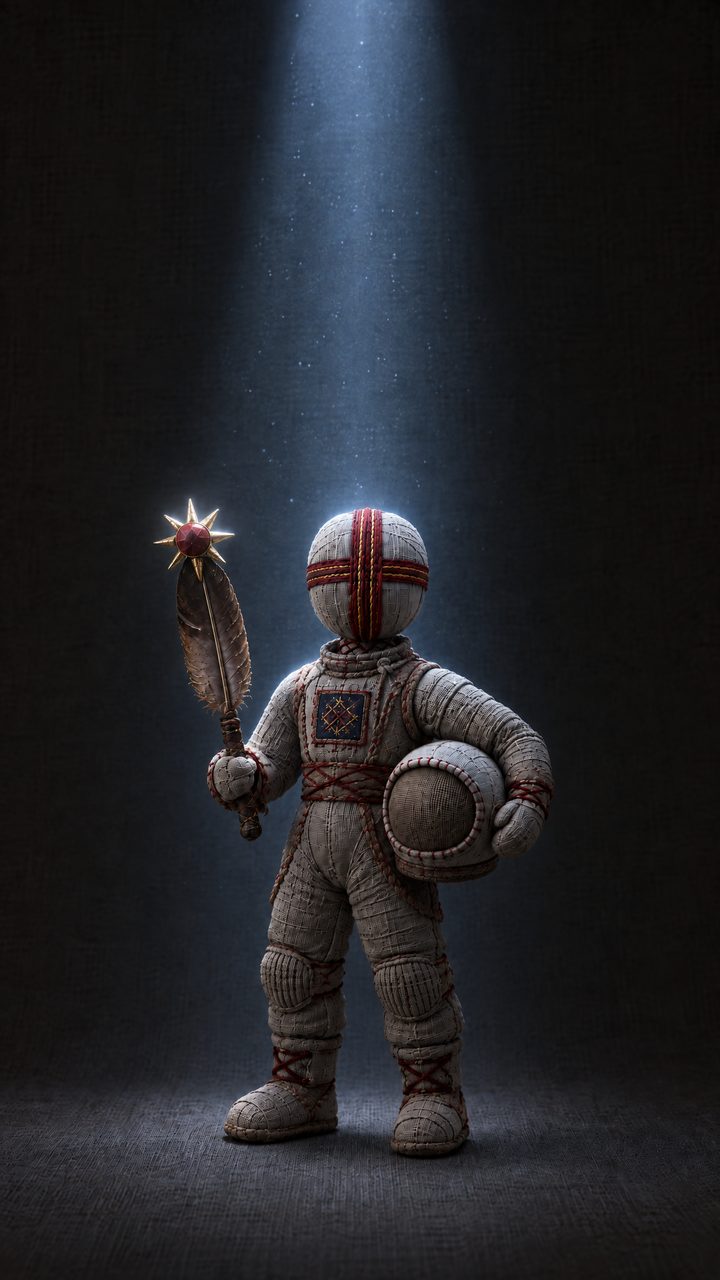
Mr. GetMen is two figures: the Scribe who writes and the Lirnyk who sings. The Lirnyk is a faceless cloth doll (a motanka) with a woven ribbon cross for a face and a feather that is also a star, and he changes costume for every song. For this one he became a cosmonaut in a linen spacesuit.
“The generator kept trying to turn the cross into a blindfold, and it took a separate prompt to bring the cross back.”
For the full account of the Scribe and the Lirnyk, see our interview with Mr. GetMen.
What the money did: two campaigns, two countries
In October he ran two small Google Ads video campaigns for the full clip, one per country. These are his figures, and the clip he advertised runs 6:26, a second longer than the 6:25 track.
Together about 5,500 UAH, about $122.
Ukraine came in under half a cent a view. OursA US view cost about eight times a Ukrainian view (1.60 UAH against 0.19 UAH).
Ukraine: more than half of the views came from TV screens. USA: most impressions went to tablets, most views came from phones.
Our drawingEach metric is scaled to its own larger value, so compare the two bars inside a metric, not across metrics. Spend, impressions, views, view rate and cost per view are as he reported them. Combined, the two campaigns delivered 17,750 views for 5,490 UAH, which is our sum of his two country figures.
His reading is the same as with the $200 campaign in our first interview: ads buy attention, not an audience.
Retention on the full clip
His figures from YouTube analytics on the 6:26 clip. The three bars are three measured points, not a curve; nothing between them was reported.
The same six questions, for every artist
We ask every artist we feature the same six questions, so that answers can later be compared across songwriters. Here are his, drawn from this song and from what he told us earlier.
| Question | Mr. GetMen |
|---|---|
| How many generations to a keeper? | Fourteen, then eight remix rounds from the last one. |
| What did you change after the take was right? | He took the last generation and remixed it (seven kept, stopped at the eighth). Earlier he had changed the rhythmic base instead of the voice, slowed the track, and removed “spoken-singing” from the lyrics. |
| What did distribution ask? | Nobody asked how the music was made, as with his earlier releases. He discloses it himself everywhere: words by a human, music and vocals by AI. YouTube, TikTok and Instagram all have an AI label, and for songs he always chooses it. For Shorts he does not, because they are teasers cut from a song that already carries the label. |
| Did you disclose AI, and why? | Yes. In his words from earlier correspondence: “Disclosure started as an ethical preference for me and turned out to be a hedge.” |
| What did the money do? | About 5,500 UAH (about $122) across two October campaigns bought 17,750 views and, in his words, attention and not an audience. By country: see the chart above. On an earlier track, $200 of ads bought 140,000 views and no new subscribers. |
| What is the one thing the tool cannot do? | It cannot know which line the whole song leans on. Suno sang “Not enough craters on the Moon for our names” and kept breaking it into pieces until he took the ellipses out. It sang the words; it did not know they were the point. Earlier he put it this way: “you cannot prompt your way to a hook.” |
Release log: October 2026
He agreed that the figures and his six answers can go into a public release log that we update each month, track by track. This is the first entry. A blank cell means he has not given us the figure, not that it is zero.
| Track | Released | Generations, remixes, length | Ads and response |
|---|---|---|---|
| Earlier track (3:27) | date not given | not reported | $200 of YouTube ads: 140,000 views, 83% in Ukraine, average watch 2:31 (about 73% of the track), 0 new subscribers. Source: our first interview. |
| “Not Enough Craters” | 16 October 2026 | 14 generations, 8 remix rounds (7 kept), 6:12 first version, 6:25 final. | Two Google Ads video campaigns, October: Ukraine 3,009 UAH, 16,200 views; USA 2,481 UAH, 1,550 views. Clip retention: 2:01 average (31.5%), 43% at 0:30, about 15% to the end. Distribution asked nothing about how it was made. |
| “Chary Kayattya” (“Spells of Repentance”) | 23 October 2026 | not yet reported | not yet reported |
| “The Final Jackpot” | 30 October 2026 | not yet reported | not yet reported |
Next entry: November 2026, with the 20 November release of a Ukrainian track, “Polyuvannia divy” (The Maiden’s Hunt).
What it means to him
A commenter under one of his posts about the song replied that they choose to be positive, and named the Artemis program as one of the good things happening in the world. His own reading is plainer.
“For me this song is a manifesto against war. Enough. After five years of war here, I want peace more than anything. Space, the Moon, Mars, that is where all our effort and money should go. Build, create, bring to life, not destroy.”
Listen
Frequently asked questions
Why did Suno return a melody almost identical to his previous song?
He had rewritten his style prompt as modern cinematic rock after a Bowie-like prompt with mellotron and vintage pads returned “pure seventies”. Suno then returned a melody almost identical to “Sinners in Your Eyes”, with the same baritone and the same sustained notes, because that was the nearest familiar template. He changed the rhythmic base instead of the voice and slowed the track. One song, so a lead and not a rule.
Why did Suno break the title line into pieces?
Ellipses around the title line made Suno split it. Written as one unbroken phrase, “Not enough craters on the Moon for our names” sang as one. In his words, the tool sang the words but did not know they were the point of the song.
How many Suno generations did the song take?
Fourteen generations, then eight remix rounds from the last one, with seven remixes kept and the eighth where he stopped. The first version ran 6:12; the final track runs 6:25.
What did two small Google Ads campaigns buy for an AI-made song?
Ukraine: 3,009 UAH (about $67), 107,000 impressions, 16,200 views, about 0.19 UAH per view. USA: 2,481 UAH (about $55), 13,400 impressions, 1,550 views, about 1.60 UAH per view. His summary: ads buy attention, not an audience. One song and two campaigns, not a benchmark.
Did he label the song as AI-made?
Yes, everywhere. The words are written by a human and the music and vocals are made by AI. He picks the AI label on YouTube, TikTok and Instagram for songs, and does not for Shorts, which are teasers cut from a song that already carries the label.
Sources
- Mr. GetMen, written correspondence with Rinzara, August to November 2026, including his making-of notes and his answers of 1 November 2026. Every quote and figure attributed to him on this page comes from that correspondence, and he approved the draft before publication, with the corrections applied here.
- Wikipedia: Earthrise, for the photograph, its photographer, date and rotation note.
- Wikipedia: Apollo 8, for the Christmas Eve broadcast reading from Genesis.
- Wikipedia: Artemis II, for the launch date, the planned loss of signal, the cookies, the crater names and the Earthset caption. The page’s own signal-loss times (22:46 to 23:24 UTC) differ from its stated 40 minutes by two minutes.
- NewsNation: Victor Glover’s message about love, for his 6 April 2026 remarks to ground control.
- Wikipedia: The Conquest of Interplanetary Spaces (1929, Novosibirsk, 2,000 copies, printed at the author’s expense). The biography page for Yuri Kondratyuk gives 21 June 1897 in Poltava and lists the book under 1925; we follow the book’s own page for the print year and print no earlier year for his lunar-route work.
- Suno, the generator used for the music and vocals.
This article is an interview and educational information, not legal advice. Platform policies on AI-made music are changing quickly; confirm current rules with each platform before relying on them. Published November 2026.